.JPG)


This newsletter reports 418 new meteorites from the 2004 and 2006 ANSMET seasons from the Cumulus Hills (CMS), LaPaz Ice Field (LAP), Graves Nunataks (GRA), Grosvenor Mountains (GRO), Larkman Nunatak (LAR), MacAlpine Hills (MAC), Miller Range (MIL), Roberts Massif (RBT), and Scott Glacier (SCO). These new samples include one iron, 1 eucrite, 1 mesosiderite, 6 CK chondrites (2 with pairing), 2 CV3 chondrites, 1 CM1, 7 CM2 (4 with pairing), 3 CR2 (2 with pairing), and one each of a type 3 L and H chondrites. The CK6 chondrites (LAR 06869, 06872, 06873) are unusual in that they have no discernable chondrules, extremely fine-grained texture, and are full of veins. This newsletter represents a break from recent newsletters in which we have announced many unusual and popular samples, including new lunar and martian meteorites, an unusual achondrite (GRA 06128 and 06129 – the topic of a special session at this years LPSC).
Last fall we received the third highest number of requests for samples since the start of the program in 1977 (73), yet we also continue to announce >300 new meteorites in newsletters. This combined level of activity from the field teams, Smithsonian and NASA-JSC has resulted in the allocation of >600 samples to 87 PI's, including thin sections, since last year at this time. With such a high load of samples, there can be temporary delays, and we appreciate everyone's patience during these busy periods.
This newsletter also marks the completion of characterization and announcement of the 2004 season samples. To see a summary of the seasons finds, you can search "2004" in our Classification database online.
During the recently completed 2007-2008 ANSMET field season the field team recovered a specimen (presumably a meteorite) fully enclosed within blue ice. Although specimens partially enclosed in ice have been recovered and studied before, the 2007 specimen is unique in two important ways. First, it is fully enclosed by ice and thus potentially sealed off from any anthropogenic contamination; second, it is larger than any previously discovered "in-ice" specimen (4-5 cm in longest dimension), making it easier to work with. The block of ice (roughly 30x45x60 cm) containing the new specimen is currently en route to the Meteorite Processing Laboratory at JSC, sealed in a double set of nylon bags and kept frozen since recovery. It should arrive at JSC in early April.
|
The Meteorite Working Group would like to receive proposals from researchers interested in joining a consortium that will extract this specimen from the ice and conduct in situ sampling of the ice or the meteorite specimen at the moment of extraction. The following ground rules apply:
If you would like to be involved in the extraction of this meteorite, please prepare a short (1 page) proposal describing exactly what you’d like to do (sample or direct measurement needs, samples sizes, etc) and your willingness to participate. Proposals should be sent to Ralph Harvey via email (rph@case.edu) no later than March 21, 2008. The Meteorite Working Group will review these proposals in late March and the consortium will be formed shortly thereafter. We anticipate extracting the meteorite in mid- to late-summer.
Antarctic
Meteorite Workshop - July 26-27, 2008 at Matsue Meteoritical Society
At the upcoming Meteoritical Society meeting in Matsue, Japan (July 28 - August 1, 2008), there will be a pre-meeting Antarctic Meteorite Workshop hosted by the NIPR and MetSoc. The purpose of the workshop is to gather meteoriticists to discuss issues relating to these collections, and how to allow these new discoveries to have the largest impact on our field. The workshop format will allow discussion of topics not usually covered during the regular sessions of the Meteoritical Society meeting. Specifically, the topics of interest will include the search, recovery, classification, weathering and curation of Antarctic Meteorites. Information about the workshop will be distributed soon.
Changes and Additions to the US Antarctic Meteorite Webpage
Some substantial changes and additions have been made to our webpage recently, including an updated sample request form, addition of an updated master list and spreadsheet for all samples in the US Antarctic meteorite collection (cross-checked against the Meteoritical Bulletin announcements), and a summary of bandsawing at NASA-JSC and the Smithsonian Institution. Also, augmentation of photographic information available about the US Antarctic meteorite collection continues on our webpage. You will notice many new photos of achondrites announced in pre-1996 newsletters. These photos will be added for all classes of meteorites over the next few months, so please watch for updates. There are some beautiful photos taken of samples from the period 1977 to 1995 that have only been available in hard copy through JSC. Now many of these will be available electronically on our webpage in the "Classification Database" section.
Availability of Possible Impact Crater Feature in LAP 02200
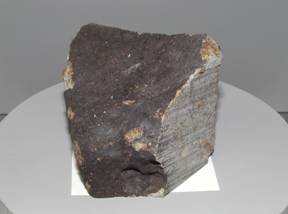
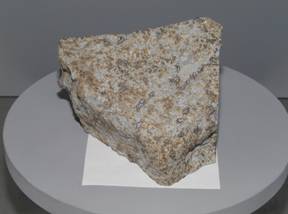
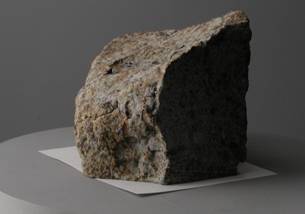
NASA-JSC scientist, Mark Cintala received four ~400 g bandsawed pieces of the large LL6 chondrite LAP 02200 in May 2007 for shock experiments in his lab at JSC. After sandblasting the fusion crust off of the samples, which is customary for these shock experiments, Cintala observed what looks like a pre-existing impact crater and spallation zone in this chondrite sample. In order to preserve this feature for study by other researchers, he has traded two pieces with these features for two different pieces of LAP 02200. Below are several photos of this sample, before and after sandblasting, and then after one shock experiment, showing the artificial crater as well as the potential natural crater. If you are interested in studying these samples, please contact us through the normal request channel, but it may be beneficial to speak with the curator in advance of such a request to discuss sample dimensions, sampling needs, etc.
|
||||||||||||||||
|---|---|---|---|---|---|---|---|---|---|---|---|---|---|---|---|---|
Staff Changes at the Smithsonian
This newsletter announces the end of the classification of the 04’s and continues working through the 06’s. It also marks a significant transition at the Smithsonian. The staff of the Div. of Meteorites is growing and changing. LuElla Speakman has joined our staff as a Collections Technician and will assume responsibility for samples that are permanently transferred to the Smithsonian. Also joining our staff as a trust-funded Geologist is Cari Corrigan, who has twice traveled to Antarctica to collect meteorites and previously worked as a postdoctoral fellow with us. She joins us in what we anticipate to be an ongoing position funded in part by an endowment generously provided by former curator Ed Henderson. Cari will assume the day-to-day responsibilities in the classification of Antarctic meteorites and will serve as the Smithsonian’s representative to the Meteorite Working Group. Linda Welzenbach continues as Collection Manager and serves as the Fall Secretary for the Meteorite Working Group. Finally, I am moving from the MWG, where I have served for a decade, to the Meteorite Steering Group, replacing Glenn MacPherson who served on the Steering Group. We are extremely pleased to welcome LuElla and Cari and will continue to make sure the high level of service you have come to expect from the Smithsonian continues.
Results From the 2007-2008 ANSMET Field Season
Ralph Harvey, ANSMET
Sometimes it starts with just one little find. Back in 1985 the US Antarctic Research Program established a remote helicopter camp on the Bowden Névé (Beardmore South Camp), an effort designed to promote field explorations in the mid-Transantarctic Mountains. It worked, at least for us; with a bit of helicopter support and some snowmobile traversing, during that season my predecessor (Bill Cassidy) and his team discovered the meteorite concentrations near Lewis Cliff, the Queen Alexandra Range, the Grosvenor Mountains, the Geologists Range, and the Miller Range. More than 8000 LEW, QUE, GRO, GEO and MIL meteorites have been recovered over the past 22 years as a result, and there are more to come.
During that prodigal season, Bill and company found only a single meteorite on ice near the Miller Range; that find took a back seat to the dense concentrations found at Lewis Cliff and nearby areas. But that lone H5 wasn’t forgotten. In 1999 we sent a two person team back to the Miller Range, where 30 meteorites found in a day and vast extents of blue ice revealed enormous potential. A four-person team found another 100 or so meteorites in 2003, and in 2005 a full 8-person, 6-week and weather-confounded expedition found about 170 more. The Miller Range icefields yielded many meteorites of unique interest as a result of these efforts, including lunar and martian specimens; so while the numbers weren't huge, the potential of the Miller Range icefields continued to grow.
The just-completed 2007-2008 field season was the first to really exploit that potential. Good weather and lighter snow cover allowed more than 700 meteorites to be recovered, including a good number of non-OC specimens. Our efforts were concentrated on the informally-named Middle Icefields, sitting (rather obviously) between the North icefields partially searched in 2005, and the as-yet unsearched South icefields. Searching conditions were interesting, to say the least. Around the north and east ends of the Middle Icefield are myriad separate patches of exposed ice and hard firn, with both meteorites and terrestrial rocks unevenly scattered on their surfaces. We set ourselves to search all the potential stranding surfaces, not just the convenient ones, and meteorites were found in some very unexpected settings, including the steep slopes of local nunataks. We also used special techniques to recover several "ultraclean" meteorite samples to support detailed chemical and biological investigations; these will be fully described and made available in a future newsletter. Another meteorite (at least we think it's a meteorite) was found while still fully submerged in the ice. The block of ice containing this specimen was collected; look elsewhere in this newsletter for a description of what we hope to do with this sample.
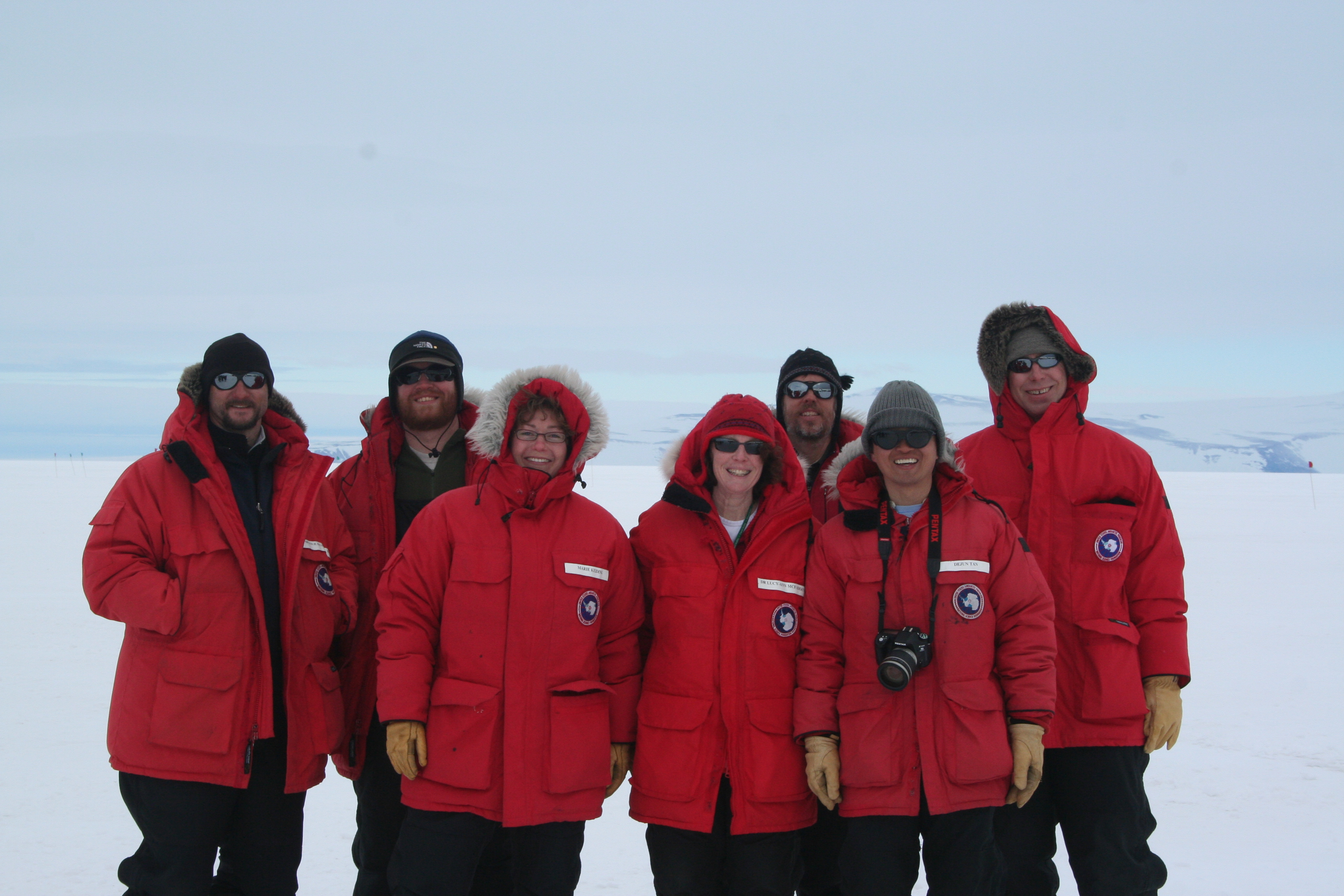
My thanks to the field team, which consisted of Les Bleamaster III, Marc Caffee, Marc Fries, Marie Keiding, Lucy McFadden, John Schutt, Tim Swindle, Dejun Tan and me. Several future seasons will be required to complete the harvest of meteorites from the Miller Range and I think they'll all agree it's something to look forward to.
 |
Reclassifications
In the last newsletter (AMN 30, no. 2) we announced 10 reclassifications of various chondrites and achondrites. Continuing to update our database, here are listed re-classifications of various carbonaceous, enstatite and R chondrites. These are based on either new published information or correction of terminology. Also, R chondrites were rare about a decade ago, and now we have 20 in the US collection making the subtypes more important for distinction. We anticipate more in future newsletters, and we thank Jeff Grossman for his aid in identifying many of these.
Sample |
Previous |
New |
References |
|---|---|---|---|
|
|
|
|
ALH 85005 |
C2 |
CM2 |
See notes below |
ALH 85007 |
C2 |
CM2 |
" |
ALH 85008 |
C2 |
CM2 |
" |
ALH 85009 |
C2 |
CM2 |
" |
ALH 85010 |
C2 |
CM2 |
" |
ALH 85011 |
C2 |
CM2 |
" |
ALH 85012 |
C2 |
CM2 |
" |
ALH 85013 |
C2 |
CM2 |
" |
ALH 85106 |
C2 |
CM2 |
" |
ALH 90407 |
C2 |
CM2 |
" |
ALHA 81312 |
C2 |
CM2 |
" |
EET 83224 |
C2 |
CM2 |
" |
EET 83250 |
C2 |
CM2 |
" |
EET 83389 |
C2 |
CM2 |
" |
EET 90021 |
C2 |
CM2 |
" |
EET 90043 |
C2 |
CM2 |
" |
EET 92005 |
C2 |
CM2 |
" |
EET 92007 |
C2 |
CM2 |
" |
EET 92008 |
C2 |
CM2 |
" |
EET 92009 |
C2 |
CM2 |
" |
EET 92010 |
C2 |
CM2 |
" |
EET 96005 |
C2 |
CM2 |
" |
EET 96006 |
C2 |
CM2 |
" |
EET 96007 |
C2 |
CM2 |
" |
EET 96011 |
C2 |
CM2 |
" |
EET 96012 |
C2 |
CM2 |
" |
EET 96013 |
C2 |
CM2 |
" |
EET 96014 |
C2 |
CM2 |
" |
EET 96016 |
C2 |
CM2 |
" |
EET 96017 |
C2 |
CM2 |
" |
EET 96019 |
C2 |
CM2 |
" |
EET 96096 |
C2 |
CM2 |
" |
EET 96097 |
C2 |
CM2 |
" |
EET 96098 |
C2 |
CM2 |
" |
EET 96226 |
C2 |
CM2 |
" |
GRO 85202 |
C2 |
CM2 |
" |
LEW 85306 |
C2 |
CM2 |
" |
LEW 85307 |
C2 |
CM2 |
" |
LEW 85309 |
C2 |
CM2 |
" |
LEW 85311 |
C2 |
CM2 |
" |
LEW 85312 |
C2 |
CM2 |
" |
LEW 86004 |
C2 |
CM2 |
" |
LEW 86005 |
C2 |
CM2 |
" |
LEW 86007 |
C2 |
CM2 |
" |
LEW 86008 |
C2 |
CM2 |
" |
LEW 86009 |
C2 |
CM2 |
" |
LEW 87016 |
C2 |
CM2 |
" |
LEW 87148 |
C2 |
CM2 |
" |
LEW 87271 |
C2 |
CM2 |
" |
LEW 88001 |
C2 |
CM2 |
" |
LEW 88002 |
C2 |
CM2 |
" |
LEW 88003 |
C2 |
CM2 |
" |
LEW 90500 |
C2 |
CM2 |
" |
MAC 88101 |
C2 |
CM2 |
" |
MAC 88176 |
C2 |
CM2 |
" |
PCA 91008 |
C2 |
CM2 |
" |
QUE 93005 |
C2 |
CM2 |
" |
QUE 93018 |
C2 |
CM2 |
" |
WIS 91608 |
C2 |
CM2 |
" |
|
|
|
|
EET 90047 |
C2 |
CM1/2 |
1 |
EET 83334 |
CM1-2 |
CM1 |
1 |
LAP 031214 |
CM1-2 |
CM1/2 |
It is intermediate between 1 and 2 |
MAC 02820 |
CM1-2 |
CM1/2 |
It is intermediate between 1 and 2 |
ALH 83100 |
CM2 |
CM1/2 |
1 |
GRO 95566 |
C2 |
C2-ung |
2 |
|
|
|
|
QUE 94411 |
CB |
CBb |
3 |
QUE 94627 |
CB |
CBb |
3 |
QUE 99309 |
CB |
CBb |
3 |
|
|
|
|
PCA 82500 |
CK4-5 |
CK4/5 |
It is intermediate between 4 and 5 |
EET 87860 |
CK5-6 |
CK5/6 |
It is intermediate between 5 and 6 |
|
|
|
|
ALH 82101 |
CO3 |
CO3.4 |
4 |
ALH 83108 |
CO3 |
CO3.5 |
5 |
ALH 85003 |
CO3 |
CO3.5 |
4 |
ALHA 77003 |
CO3 |
CO3.6 |
6,7 |
ALHA 77029 |
CO3 |
CO3.4 |
6 |
MET 00694 |
CO3 |
CO3.6 |
AMN 26, no. 1 |
CO3 |
CO3.6 |
AMN 26, no. 1 |
|
ALHA 77307 |
CO3 (?) |
CO3.0 |
8 |
|
|
|
|
ALH 82132 |
E4 |
EH4 |
9 |
QUE 93513 |
E4 |
EH4 |
9 |
QUE 94368 |
E5 |
EL4 |
10 |
TIL 91714 |
E5 |
EL5 |
11 |
LON 94100 |
E6 |
EL6 |
12 |
QUE 99473 |
EH |
EH-imp melt |
AMN 25, no.2 |
EET 87746 |
EH3 |
EH4 |
13 |
EET 96135 |
EH4-5 |
EH4/5 |
It is intermediate between 4 and 5 |
EET 96202 |
EH4-5 |
EH4/5 |
It is intermediate between 4 and 5 |
EET 96217 |
EH4-5 |
EH4/5 |
It is intermediate between 4 and 5 |
EET 96223 |
EH4-5 |
EH4/5 |
It is intermediate between 4 and 5 |
EET 96299 |
EH4-5 |
EH4/5 |
It is intermediate between 4 and 5 |
EET 96309 |
EH4-5 |
EH4/5 |
It is intermediate between 4 and 5 |
EET 96341 |
EH4-5 |
EH4/5 |
It is intermediate between 4 and 5 |
LEW 88180 |
EH6 |
EH5 |
11 |
LEW 87119 |
EL6 (7?) |
EL6 |
7 not verified |
QUE 97289 |
E-ungr |
Aubrite-an |
Paired with QUE94204 |
QUE 97348 |
E-ungr |
Aubrite-an |
Paired with QUE94204 |
LAP 03780 |
Aub (Anom) |
Aubrite |
AMN 27, no. 3 |
|
|
|
|
ALH 85151 |
R |
R3.6 |
14 |
PCA 91002 |
R |
R3.8-6 |
15 |
PCA 91241 |
R |
R3.8-6 |
15 |
PRE 95410 |
R |
R3 |
AMN 20, no. 2 |
PRE 95411 |
R |
R3 |
AMN 20, no. 2 |
PRE 95412 |
R |
R3 |
AMN 20, no. 2 |
LAP 031135 |
R |
R4 |
AMN 29, no. 1 |
LAP 031144 |
R |
R4 |
AMN 29, no. 2 |
LAP 031156 |
R |
R4 |
AMN 29, no. 1 |
LAP 031275 |
R |
R5 |
AMN 29, no. 2 |
LAP 031387 |
R |
R4 |
AMN 29, no. 2 |
LAP 03639 |
R |
R4 |
AMN 29, no. 2 |
LAP 03731 |
R |
R4 |
AMN 29, no. 2 |
LAP 03793 |
R |
R4 |
AMN 29, no. 2 |
LAP 03902 |
R |
R4 |
AMN 29, no. 2 |
LAP 04840 |
R |
R6 |
AMN 29, no. 1 |
LAP 04845 |
R |
R4 |
AMN 29, no. 2 |
PRE 95404 |
CV3 |
R3 |
16 |
Notes and references: Many carbonaceous chondrites were initially classified as C2 in early newsletters. These are mostly CM2, based on matrix properties, chondrules abundance and sizes, and therefore all these samples have been reclassified more specifically here as CM2. References for other samples: 1) Zolensky et al., 1997, GCA 61, 5099-5115; 2) Clayton and Mayeda, 1999, GCA 63, 2089-2104; 3) Weisberg et al., 2001, MAPS 36, 401-418; 4) D.W.G.Sears et al., 1991, Proc. NIPR Symp. Ant. Met. 4, 319; 5) R.H.Jones, 1997, Workshop on Modification of Chondritic Materials, LPI Tech. Rpt. 97-02, Part 1, p.30 (abs.); 6) subtype classification, E.R.D.Scott and R.H.Jones, 1990, GCA 54, 2485; 7) TL data, petrologic type 3.4, D.W.G.Sears et al., 1991, Proc. NIPR Symp. Ant. Met. 4, 319; 8) Grossman, J.N. and Brearley, A. (2005) MaPS 40, 87-122; 9) A.E.Rubin and E.R.D.Scott, 1997, GCA 61, 425; 10) A.E.Rubin, 1997, LPSC 28, 1201; 11) A.E.Rubin et al., 1995, LPSC 26, 1197; 12) A.E.Rubin et al., 1997, GCA 61, 849; 13) Y.Zhang et al., 1995, J. Geophys. Res. 100, 9417–9438; 14) A.E.Rubin and G.W.Kallemeyn, 1989, GCA 53, 3035; 15) Rubin, A.E. and Kallemeyn, 1994, Meteoritics 29, 255-264; 16) G.W.Kallemeyn, 1998, MAPS 33, p.A80 (abs.).
Terrestrial Age Survey of Antarctic Meteorites
Kuni Nishiizumi and Kees Welten
We are continuing a terrestrial age survey of Antarctic meteorites, based on the concentration of cosmogenic 36Cl (half-life = 3.01x10⁵ yr) in the metal fraction. After separation of clean metal and chemical separation of Cl at the Space Sciences Laboratory, University of California, Berkeley, the 36Cl concentrations were measured by accelerator mass spectrometry (AMS) at PRIME Lab, Purdue University (mcaffee@purdue.edu). Table 1 shows the results of 36Cl concentrations and terrestrial ages in 100 Antarctic meteorites that were measured since our last report in Antarctic Meteorite Newsletter (Volume 29, Number 1, 2006). Since the 36Cl saturation values in the metal phase of small to medium-sized meteorites are in a relatively narrow range of 19-25 dpm/kg (2σ), the measured 36Cl concentrations yield a direct measure of the terrestrial age (Nishiizumi et al. 1989). The apparent terrestrial age, T(terr), (in kyr) can be calculated using the following equation:
T(terr) = -434 x ln(A/A0)
where A is the measured 36Cl concentration and A0 is the average 36Cl saturation value of 22.1±2.8 dpm/kg (2s) (Nishiizumi 1995). For meteorites with 36Cl concentrations >22.1 dpm/kg we only report an upper limit of the terrestrial age, whereas for meteorites with 36Cl concentrations between 19.3 and 22.1 dpm/kg, we report the possible range of terrestrial ages, with the age and error in Table 1 having the same value, e.g. 37±37 kyr instead of 8±57 kyr for ALHA 79016. For meteorites with 36Cl concentrations <19 dpm/kg there is a small possibility that these low values are due to unusually high shielding conditions or a short exposure age, but this can only be verified by measuring additional cosmogenic nuclides.
For more information about the 36Cl results, or the terrestrial ages, please contact Kees Welten (kcwelten@berkeley.edu) or Kuni Nishiizumi (kuni@ssl.berkeley.edu). This work was supported by NASA’s Cosmochemistry Program.
References
Nishiizumi K., Elmore D. and Kubik P. W. (1989) Update on terrestrial ages of Antarctic meteorites Earth Planet. Sci. Lett. 93, 299-313.
Nishiizumi K. 1995. Terrestrial ages of meteorites from cold and cold regions. In Workshop on meteorites from cold and hot deserts. (eds. L. Schultz, J. O. Annexstad and M. E. Zolensky) pp. 53-55. LPI Technical Report No. 95-02, Lunar and Planetary Institute, Houston, Texas.
Table 1. Measured 36Cl concentrations (in dpm/kg-metal) and 36Cl-derived terrestrial ages (in kyr) of Antarctic meteorites.
Meteorite |
Type |
36Cl |
T(terr) |
|
Meteorite |
Type |
36Cl |
T(terr) |
|---|---|---|---|---|---|---|---|---|
ALHA 79012 |
H5 |
23.1±0.5 |
<43 |
|
LAR 04328 |
H5 |
18.6±0.7 |
76±57 |
ALHA 79016 |
H6 |
21.7±0.7 |
37±37 |
|
MAC 87307 |
H4 |
17.6±0.3 |
98±55 |
ALHA 79018 |
L6 |
21.1±0.5 |
42±42 |
|
MAC 88119 |
H5 |
15.5±0.4 |
150±60 |
ALH 94001 |
L4 |
17.9±0.8 |
91±58 |
|
MAC 88175 |
LL6 |
13.0±0.5 |
230±60 |
ALH 97100 |
L6 |
13.6±0.5 |
210±60 |
|
MAC 02452 |
LL5 |
17.6±0.6 |
99±57 |
ALH 97101 |
H5 |
16.5±0.5 |
125±60 |
|
MAC 02454 |
L4 |
24.8±1.6 |
<31 |
ALH 99506 |
L5 |
14.8±0.5 |
175±60 |
|
MAC 02458 |
LL6 |
22.6±0.9 |
<60 |
CMS 04001 |
L5 |
22.5±0.5 |
<53 |
|
MAC 02601 |
L4 |
23.9±0.7 |
<30 |
CMS 04002 |
LL6 |
22.4±0.8 |
<63 |
|
MAC 02832 |
H5 |
20.2±0.7 |
53±53 |
CMS 04010 |
LL5 |
22.3±0.6 |
<60 |
|
MAC 02918 |
L4 |
22.8±0.8 |
<27 |
CMS 04019 |
H6 |
21.5±0.5 |
38±38 |
|
MET 00437 |
L6 |
15.2±0.4 |
160±60 |
DOM 03195 |
LL6 |
24.0±0.5 |
<28 |
|
MET 00442 |
H4 |
17.4±0.7 |
100±60 |
DOM 03260 |
LL5 |
20.5±0.5 |
51±51 |
|
MET 00444 |
LL6 |
16.9±0.7 |
120±60 |
FIN 01602 |
H5 |
24.3±0.5 |
<26 |
|
MET 00445 |
L5 |
17.7±0.7 |
96±58 |
FIN 01604 |
H5 |
25.5±0.5 |
< 5 |
|
MET 00447 |
L5 |
18.1±0.7 |
88±57 |
GEO 99102 |
H4 |
23.3±0.5 |
<40 |
|
MET 00449 |
LL6 |
21.7±0.6 |
36±36 |
GEO 99104 |
L6 |
20.3±0.5 |
53±53 |
|
MET 00461 |
L6 |
20.3±0.7 |
52±52 |
GEO 99109 |
H4 |
23.4±0.5 |
<53 |
|
MIL 99310 |
L5 |
23.6±0.9 |
<40 |
GRA 98013 |
H4 |
14.2±0.5 |
190±60 |
|
MIL 03362 |
LL5 |
19.9±0.8 |
55±55 |
GRA 98118 |
L6 |
22.2±0.5 |
<64 |
|
PCA 02002 |
L5 |
19.7±0.7 |
60±60 |
GRO 95526 |
L6 |
18.7±0.8 |
73±60 |
|
PCA 02003 |
H5 |
20.4±0.6 |
50±50 |
GRO 95528 |
L6 |
7.4±0.2 |
470±60 |
|
QUE 93019 |
L6 |
24.8±0.7 |
<14 |
GRO 95529 |
L5 |
21.9±0.5 |
34±34 |
|
QUE 93046 |
H5 |
22.7±0.5 |
<51 |
GRO 95532 |
H6 |
18.4±0.7 |
79±57 |
|
QUE 93182 |
L5 |
21.0±0.5 |
43±43 |
GRO 95537 |
H5 |
19.9±1.0 |
59±59 |
|
QUE 93264 |
L6 |
20.2±0.5 |
50±50 |
GRO 95538 |
H5 |
18.6±0.7 |
75±57 |
|
QUE 93572 |
H5 |
19.7±0.5 |
57±57 |
GRO 95540 |
L5 |
14.7±0.6 |
180±60 |
|
QUE 93711 |
H5 |
21.2±0.5 |
40±40 |
GRO 95541 |
H4 |
19.6±0.8 |
60±60 |
|
QUE 93724 |
L6 |
15.1±0.3 |
165±55 |
GRO 95547 |
H6 |
18.6±0.9 |
74±59 |
|
QUE 94237 |
H5 |
18.1±0.5 |
86±56 |
GRO 95552 |
LL4 |
20.5±0.6 |
49±49 |
|
QUE 94243 |
H6 |
20.3±0.7 |
52±52 |
GRO 95553 |
L6 |
18.9±0.9 |
69±59 |
|
QUE 94501 |
H6 |
19.7±0.3 |
54±54 |
GRO 95556 |
LL6 |
19.7±0.5 |
56±56 |
|
QUE 94719 |
L6 |
21.8±0.4 |
32±32 |
GRO 95557 |
LL5 |
16.0±0.4 |
140±56 |
|
RBT 03531 |
H5 |
23.5±0.5 |
<35 |
GRO 95590 |
LL4 |
18.9±0.6 |
68±57 |
|
SAN 03453 |
LL5 |
11.3±1.4 |
290±80 |
GRO 95607 |
L6 |
20.8±1.0 |
50±50 |
|
SAN 03458 |
LL6 |
19.9±0.4 |
55±55 |
GRO 95616 |
L4 |
17.6±0.6 |
99±57 |
|
SAN 03461 |
L6 |
20.7±0.6 |
46±46 |
GRO 03017 |
LL5 |
13.8±0.5 |
200±70 |
|
SAN 03480 |
L5 |
19.5±0.5 |
59±59 |
GRO 03032 |
H5 |
17.6±0.5 |
98±57 |
|
SAN 03487 |
LL4 |
15.8±0.6 |
150±60 |
GRO 03051 |
H5 |
23.1±0.5 |
<46 |
|
SAN 03488 |
H5 |
21.1±0.5 |
41±41 |
GRO 03063 |
L4 |
24.2±0.5 |
<26 |
|
TIL 82400 |
L5 |
23.1±0.6 |
22±22 |
GRO 03104 |
H5 |
22.5±0.5 |
<56 |
|
TIL 82404 |
L4 |
17.5±0.3 |
100±55 |
GRO 03105 |
LL6 |
22.5±0.5 |
<57 |
|
TIL 82405 |
H6 |
21.7±0.8 |
38±38 |
GRO 03114 |
H5 |
20.1±0.5 |
58±58 |
|
TIL 82409 |
H5 |
15.5±0.5 |
155±60 |
GRO 03138 |
L5 |
23.1±1.1 |
<53 |
|
WIS 90300 |
L5 |
15.9±0.3 |
140±60 |
LAP 02204 |
L5 |
19.4±0.8 |
63±63 |
|
WIS 91602 |
L5 |
15.5±0.4 |
155±60 |
LAP 02218 |
L4 |
21.3±0.7 |
42±42 |
|
WIS 91603 |
L4 |
18.2±0.5 |
85±56 |
LAP 02230 |
LL6 |
17.6±0.8 |
100±60 |
|
WIS 91610 |
H6 |
23.4±1.1 |
<47 |
LAP 02231 |
H5 |
20.7±0.8 |
49±49 |
|
WIS 91612 |
L6 |
21.2±0.5 |
40±40 |
LAP 02266 |
LL4 |
19.8±0.5 |
55±55 |
|
WIS 91617 |
H5 |
22.5±0.5 |
<53 |
LAP 02353 |
L6 |
23.0±1.3 |
<59 |
|
WIS 91618 |
LL4 |
20.7±0.5 |
45±45 |