Top Ten Scientific Discoveries Made During Apollo Exploration of the Moon
- The Moon is not a primordial object; it is an evolved terrestrial
planet with internal zoning similar to that of Earth.
Before Apollo, the state of the Moon was a subject of almost unlimited speculation. We now know that the Moon is made of rocky material that has been variously melted, erupted through volcanoes, and crushed by meteorite impacts. The Moon possesses a thick crust (60 km), a fairly uniform lithosphere (60-1000 km), and a partly liquid asthenosphere (1000-1740 km); a small iron core at the bottom of the asthenosphere is possible but unconfirmed. Some rocks give hints for ancient magnetic fields although no planetary field exists today. - The Moon is ancient and still preserves an early history
(the first billion years) that must be common to all terrestrial
planets.
The extensive record of meteorite craters on the Moon, when calibrated using absolute ages of rock samples, provides a key for unravelling time scales for the geologic evolution of Mercury, Venus, and Mars based on their individual crater records. Photogeologic interpretation of other planets is based largely on lessons learned from the Moon. Before Apollo, however, the origin of lunar impact craters was not fully understood and the origin of similar craters on Earth was highly debated. - The youngest Moon rocks are virtually as old as the oldest
Earth rocks. The earliest processes and events that probably
affected both planetary bodies can now only be found on the Moon.
Moon rock ages range from about 3.2 billion years in the maria (dark, low basins) to nearly 4.6 billion years in the terrae (light, rugged highlands). Active geologic forces, including plate tectonics and erosion, continuously repave the oldest surfaces on Earth whereas old surfaces persist with little disturbance on the Moon. - The Moon and Earth are genetically related and formed from
different proportions of a common reservoir of materials.
The distinctively similar oxygen isotopic compositions of Moon rocks and Earth rocks clearly show common ancestry. Relative to Earth, however, the Moon was highly depleted in iron and in volatile elements that are needed to form atmospheric gases and water. - The Moon is lifeless; it contains no living organisms, fossils,
or native organic compounds.
Extensive testing revealed no evidence for life, past or present, among the lunar samples. Even non-biological organic compounds are amazingly absent; traces can be attributed to contamination by meteorites. - All Moon rocks originated through high-temperature processes
with little or no involvement with water. They are roughly divisible
into three types: basalts, anorthosites, and breccias.
Basalts are dark lava rocks that fill mare basins; they generally resemble, but are much older than, lavas that comprise the oceanic crust of Earth. Anorthosites are light rocks that form the ancient highlands; they generally resemble, but are much older than, the most ancient rocks on Earth. Breccias are composite rocks formed from all other rock types through crushing, mixing, and sintering during meteorite impacts. The Moon has no sandstones, shales, or limestones such as testify to the importance of water-borne processes on Earth. - Early in its history, the Moon was melted to great depths
to form a "magma ocean". The lunar highlands contain
the remnants of early, low density rocks that floated to the surface
of the magma ocean.
The lunar highlands were formed about 4.4-4.6 billion years ago by flotation of an early, feldspar-rich crust on a magma ocean that covered the Moon to a depth of many tens of kilometers or more. Innumerable meteorite impacts through geologic time reduced much of the ancient crust to arcuate mountain ranges between basins. - The lunar magma ocean was followed by a series of huge asteroid
impacts that created basins which were later filled by lava flows.
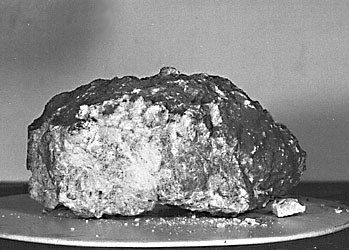
This Apollo 15 anorthosite is a white rock with a black glass coating.
The large, dark basins such as Mare Imbrium are gigantic impact craters, formed early in lunar history, that were later filled by lava flows about 3.2-3.9 billion years ago. Lunar volcanism occurred mostly as lava floods that spread horizontally; volcanic fire fountains produced deposits of orange and emerald-green glass beads. - The Moon is slightly asymmetrical in bulk form, possibly
as a consequence of its evolution under Earth's gravitational
influence. Its crust is thicker on the far side, while most volcanic basins
-- and unusual mass concentrations -- occur on the near side.
Mass is not distributed uniformly inside the Moon. Large mass concentrations ("Mascons") lie beneath the surface of many large lunar basins and probably represent thick accumulations of dense lava. Relative to its geometric center, the Moon's center of mass is displaced toward Earth by several kilometers. - The surface of the Moon is covered by a rubble pile of
rock fragments and dust, called the lunar regolith, that contains
a unique radiation history of the Sun which is of importance to
understanding climate changes on Earth.
The regolith was produced by innumerable meteorite impacts through geologic time. Surface rocks and mineral grains are distinctively enriched in chemical elements and isotopes implanted by solar radiation. As such, the Moon has recorded four billion years of the Sun's history to a degree of completeness that we are unlikely to find elsewhere.
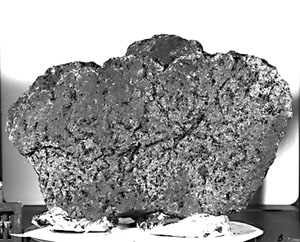
Apollo 17 basalt with dark gray igneous rock.