
Cometary Dust Particles
Image of Comet Wild-2, taken by Michael Brown on April 1, 1997.
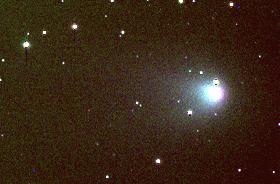
When comets struck the Earth millions of years ago they created changes in our atmosphere and climate, and brought with them water and carbon-based molecules-elements of life on this planet. By studying comet particles, scientists may be able to solve some of the mysteries surrounding the birth and evolution of life in the solar system. Comets are also believed to be the fundamental building blocks of the solar system, and their study will shed light on the origin of the Sun and planets.
Interplanetary dust particle collected from the Earth's stratosphere. This particle measures about 15 micrometers across.
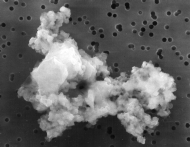
The Stardust mission captured cometary particles similar to the interplanetary dust shown here. This sample, collected high in Earth’s stratosphere using high altitude aircraft (NASA’s ER2 and WB57 aircraft), is composed of glass, carbon and many types of silicate mineral grains. It is a sample of either an asteroid or a comet, and is similar in elemental composition to primitive meteorites but differs in having higher carbon and volatile element abundance. The porosity and unusual mineralogical composition suggests that it may be a particle from a comet.