
Sample Collection
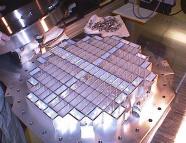
STARDUST collection tray with blocks of silica aerogel being loaded.
The Stardust collector tray consists of blocks of 1 and 3 cm thick, low-density, microporous silica aerogel mounted in modular aluminum cells. One side of the tray was used to collect samples during the comet Wild-2 encounter, and the opposite side was used for interstellar collection as the spacecraft cruised through space.
The sample harvest from Stardust consists of thousands of cometary dust particles measuring less than 100 µm each, and ~100 interstellar dust grains of mostly sub-micron size. The total mass of returned sample is estimated to be approximately 1 mg.
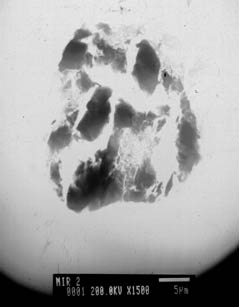
Porous interplanetary dust particle MIR1, captured in silica aerogel in low-Earth orbit on the Mir Space Station. The grain has been removed from the aerogel, thin sectioned using a diamond blade of an ultramicrotome, and is being imaged in a transmission electron microscope. The scale bar at lower right measures 5 micrometers.
On this mission, both comet coma samples and the contemporary interstellar grains were captured at high relative velocity (estimated 6.1 km/s for the comet samples) with minimal heating and other effects of physical alteration. Particle collection at this speed has been extensively demonstrated in laboratory simulations, Shuttle flights and on the MIR Space Station, and we have shown that the comet dust collection can be done with acceptable levels of sample alteration. The alteration state of captured interstellar dust was less certain because of the small particle size, higher impact velocity, and unknown material properties.
Techniques were developed for the delicate removal and analysis of captured comet grains from silica aerogel prior to the Stardust return.